Many children, and a lot of autistic children in particular, cope better with a day they can see. A row of pictures showing “shoes, coat, car” turns a vague instruction into something they can check. Playing with sequences as a game, when nothing is at stake, is a gentle way to get comfortable with them before they are needed at a busy moment.
These games are about practising the idea of a sequence. They are not a replacement for a visual schedule your child’s teacher or therapist has set up, and if your child already uses one, use the same pictures and words here.
Visual routine games to try at home
1. What comes next?
Draw or print two pictures from a routine your child knows well, such as “bath” and “towel”. Show the first and ask what comes next. Once two steps feel easy, add a third.
2. Fix the mix-up
Lay out a familiar three-step routine in the wrong order, like pyjamas, story, brush teeth, and act a little surprised. Let your child move the cards back. Many children love catching a grown-up’s mistake.
3. First, then
Use just two cards: “first” something, “then” something your child enjoys. Play it as a game with toys first (“first teddy has a bath, then teddy has a story”) before you use it for real routines.
4. Photo routine book
Take photos of your child doing three steps of something they like, such as making toast with you. Put them in a little book and read it together. Their own photos are often more meaningful than drawings.
5. Block-building plan
Draw a simple plan: red block, blue block, then a roof. Build it together, pointing at each picture as you go.
Tips for picture routines
- Start with two steps. Two is a sequence. Add more only when two is easy.
- Use routines your child already lives. Bath time, getting dressed and snack time make better first sequences than new activities.
- Keep the pictures in view. The point is to look and check, not to remember.
- More than one answer can be right. Some routines can go two ways. If your child’s order makes sense, it is a good answer.
How My Little Day practises sequences
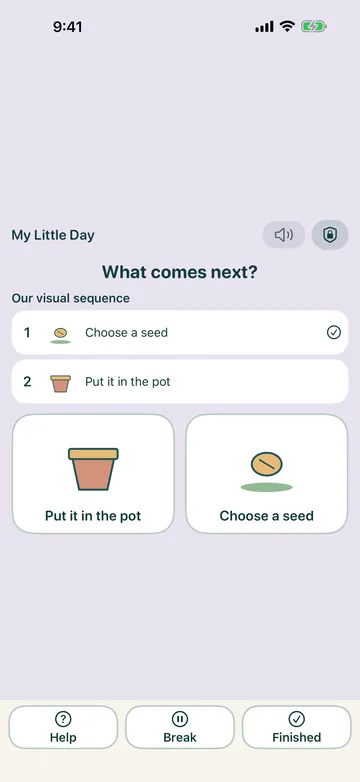
TendiPlay’s My Little Day shows a short pictured routine, such as planting a seed, and asks what happens next. The pictures stay on screen the whole time, so it is about looking and thinking rather than memory. The first level is a two-step book routine and is free. Later levels, with TendiPlay Family, move to three-step and four-step routines, including one built with large blocks.
My Little Day is a game about sequences. It is not a full visual schedule, a timetable or an AAC app.
Where TendiPlay fits
TendiPlay is a set of calm, ad-free learning games for children aged 3 to 16, made with autistic children and children with speech, language or developmental delays in mind. The first level of each of the five starter worlds is free, there are no timers or flashing rewards, and the games work offline. It is available for iPhone and iPad, with Android coming soon. See all thirteen worlds.
Get TendiPlay free on the App Store. It is coming soon to Google Play.
Common questions
What is a visual routine?
A visual routine is a short series of pictures that shows the steps of an activity in order, such as getting dressed or going to the shop. Many children find it easier to follow what they can see than a spoken instruction.
Are visual routines only for autistic children?
No. Lots of young children find picture routines helpful. They are often recommended for autistic children because many prefer predictability and understand pictures more easily than spoken words.
Is My Little Day a visual schedule app?
No. It is a learning game that practises the idea of “what comes next”. It does not plan your child’s day. Keep using any schedule your child’s school or therapist has given you.
How many steps should a routine have?
Start with two. Add one more step at a time once your child is comfortable, and keep the pictures visible while you play.
More parent guides
These guides are for playful practice with a grown-up. They are not therapy, a diagnosis or an assessment. If your child has a speech-language pathologist, occupational therapist or teacher, they know your child and their advice comes first.