Children learn words by hearing them, many times, while something interesting is happening. Games help because they give you a reason to say the same useful words again and again without it feeling like a lesson. That applies to any child, and it is especially handy for children with a speech or language delay, who often need more chances to hear a word before they use it.
These are ideas for play, not a treatment plan. If you are worried about your child’s speech or language, talk to your doctor or a speech-language pathologist. ASHA has a useful guide to telling a late bloomer from a language problem.
Language games for everyday words
1. Find it
Put two familiar things on the floor, say a cup and a ball. Ask “where’s the cup?” and let your child point, look or pick it up. Once two is easy, try three. This practises understanding words, which usually comes before saying them.
2. Feely bag
Put a few familiar toys in a bag. Take turns pulling one out and naming it. If your child does not say the word, you say it for them: “a spoon!”
3. Snack choices
Hold up two snacks and ask “apple or cracker?” Name the one your child reaches for. Offering a choice gives your child a reason to communicate, in whatever way they do.
4. Picture walk
Look at a picture book without reading the words. Point and name things together: “dog. Big dog. Dog is running.” Adding one word to what your child says is a simple way to stretch language.
5. Copy me
Make simple sounds and actions, such as clapping, “ba ba” or a car noise, and see if your child copies. Then copy them. Copying back and forth is early conversation.
Tips from everyday practice
- Talk about what your child is looking at. Following their interest works better than steering them to yours.
- Keep sentences short. One or two words more than your child uses is plenty.
- Wait. Count to five in your head after a question. Many children need that time.
- Every kind of communication counts. Pointing, signing, pictures and AAC support language; they do not hold it back.
The American Speech-Language-Hearing Association’s family site has more tips for speech and language development.
How TendiPlay practises everyday words
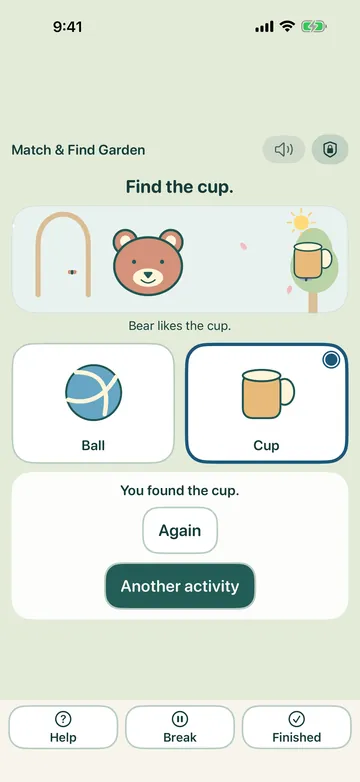
In Match & Find Garden, a friendly character asks your child to find a named, familiar picture, like the cup, from two choices. A grown-up can confirm a choice made by pointing or with AAC, so your child does not need to speak. The first level is free. For older children, Word Studio (with TendiPlay Family) moves from “listen and find” for under-sixes to reading single words, sentences and short texts, with a speaker button that repeats the question whenever it is tapped.
TendiPlay is not speech therapy and makes no promise about speech or language progress. It is a calm place to practise words you are already working on together.
Where TendiPlay fits
TendiPlay is a set of calm, ad-free learning games for children aged 3 to 16, made with autistic children and children with speech, language or developmental delays in mind. The first level of each of the five starter worlds is free, there are no timers or flashing rewards, and the games work offline. It is available for iPhone and iPad, with Android coming soon. See all thirteen worlds.
Get TendiPlay free on the App Store. It is coming soon to Google Play.
Common questions
Can games help a child with a speech delay?
Play is one of the main ways children hear and practise words, so games can be a useful part of everyday life. They are not a substitute for an assessment or therapy. If you have concerns, speak to your doctor or a speech-language pathologist.
Does my child need to talk to play TendiPlay?
No. Children choose by tapping a picture, using Switch Control, or pointing or using AAC while a grown-up confirms the choice.
What age are these language games for?
The home games suit toddlers and young children. TendiPlay covers ages 3 to 16: younger children listen and find pictures, and older children read words and short texts.
Is TendiPlay speech therapy?
No. It is playful practice to enjoy together. It does not diagnose, treat or assess, and it works alongside your child’s therapists and teachers.
More parent guides
These guides are for playful practice with a grown-up. They are not therapy, a diagnosis or an assessment. If your child has a speech-language pathologist, occupational therapist or teacher, they know your child and their advice comes first.