Taking turns asks a lot of a young child at once: waiting, watching someone else, holding on to an idea, and trusting that their go is coming back. For autistic children, and for children with a language delay, the waiting part can be the hardest, especially when the game is noisy or the rules keep changing.
The games below keep the rules tiny and the turns quick. None of them needs your child to speak. A point, a look, a sign, a switch or an AAC button all count as a turn.
Five turn-taking games you can play today
1. Build a tower together
Use a few large blocks. You add one, then offer your child the next. If they knock it down, that was a turn too. Start again. Three or four turns is a good first game.
2. One line each
On a big sheet of paper, you draw one line, then pass the crayon. Keep going until there is a house, a monster or a scribble you both like. There is no right picture, so there is nothing to get wrong.
3. Rolling a ball
Sit facing each other with legs apart and roll a soft ball back and forth. Say “my turn” and “your turn” as it moves. For a child who finds sitting still hard, try it standing against a wall.
4. Choose the next song
Take turns picking a song from two or three picture cards. Your child picks, you sing it together, then you pick. This works well in the car.
5. Feed the teddy
Give a teddy a pretend snack, then hand your child the spoon. Toys make good turn-taking partners because they never get impatient.
Tips that make turns easier
- Keep it short. Stop while it is still fun. Two good turns beat ten tense ones.
- Use the same words every time. “My turn, your turn” becomes a script your child can predict.
- Make waiting visible. Hold the block where your child can see it, or point to whose turn it is on a simple picture card.
- Let them go first sometimes. Starting a game is a skill too, and fixed turn order is not the point.
- Accept “finished”. If your child wants to stop, stop. Ending a game calmly is worth more than one more turn.
How Together Town practises turn-taking
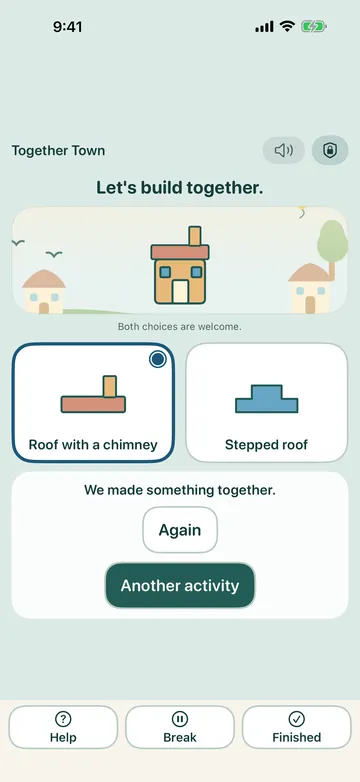
In TendiPlay’s Together Town, a child and a grown-up build a house one choice at a time: the child picks a roof or a door from two pictures, then it is the grown-up’s go. The first level is a single exchange with two choices, so a turn is over quickly. Later levels add a second exchange and a third choice. There is no timer and no score, and Help, Break and Finished are always on screen.
The parent side records whether your child chose on their own or with help, so you can see how shared play is going over a few weeks without turning it into a test.
Where TendiPlay fits
TendiPlay is a set of calm, ad-free learning games for children aged 3 to 16, made with autistic children and children with speech, language or developmental delays in mind. The first level of each of the five starter worlds is free, there are no timers or flashing rewards, and the games work offline. It is available for iPhone and iPad, with Android coming soon. See all thirteen worlds.
Get TendiPlay free on the App Store. It is coming soon to Google Play.
Common questions
What age can children start turn-taking games?
Simple back-and-forth play, like rolling a ball, often starts in the toddler years and keeps developing for a long time after. Children who need extra support may get there later or in their own way. Start with the shortest game your child enjoys.
My child gets upset when it is not their turn. What helps?
Keep turns very short, show clearly whose turn it is, and use the same words each time. Playing with a toy partner first, or letting your child go first, can take the pressure off. If it is still distressing, stop and try again another day.
Does my child need to talk to take turns?
No. Pointing, looking, signing, using a switch or an AAC device all count as taking a turn. TendiPlay lets a grown-up confirm a choice made with AAC or a gesture.
Is Together Town free?
The first level of Together Town is one of the free starter levels in TendiPlay. Later levels come with the optional TendiPlay Family subscription.
More parent guides
These guides are for playful practice with a grown-up. They are not therapy, a diagnosis or an assessment. If your child has a speech-language pathologist, occupational therapist or teacher, they know your child and their advice comes first.